

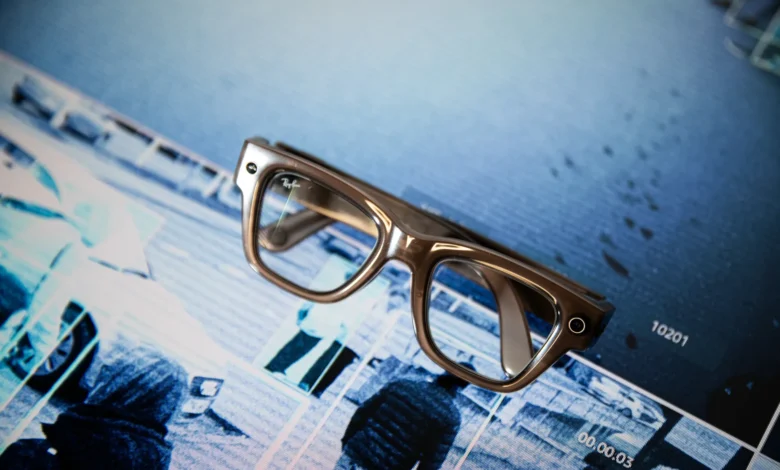
Whenever I write about Mita’s Ray-Ban-inspired smart glasses, I know the comments I’ll get. They’re cool devices, but I’m completely against any Mita product; I’ll wait for a competitor. It’s hard to imagine that changing anytime soon after The New York Times reported that Mita considered launching a facial recognition program “in a volatile political environment,” precisely because privacy advocates would be distracted.
Smart glasses enthusiasts often tell me that this fear is somewhat exaggerated. After all, the phone in your pocket has a camera too. The government already uses facial recognition technology, and surveillance cameras are ubiquitous. Anyone who’s seen a true-crime documentary or an episode of Law & Order knows that these days it’s difficult to go out in public without being filmed. The recent Guthrie case, in which law enforcement recovered Nest’s “lost” doorbell camera footage, only reinforces this point. This is one of the most worrying things about smart glasses: the cameras are tiny, their LEDs are weak, and the design is incredibly discreet. The essence of this technology is its invisibility—these recording devices look just like regular glasses.
It’s a real dilemma. Meta glasses are great because they’re discreet. But that very secrecy is worrying because it means they’re perfect surveillance tools. I’ve written about this repeatedly, but wearing these modern smart glasses often makes me feel like a spy. It doesn’t matter if the Ray-Ban Meta glasses have a privacy light indicator. I’ve worn them in public, outdoors, indoors, and at gatherings. As far as I know, no one has noticed me wearing them. Still, I don’t feel comfortable. But I’ve started noticing them in public, and that doesn’t sit well with me either. It doesn’t matter that Meta claims its glasses can’t record if the light is tampered with. 404 Media reported that a $60 modification can disable the light. Coincidentally, the privacy light on my wife’s glasses suddenly stopped working. They can record video quite well.
This is troubling enough without even mentioning Meta. What if we consider Meta’s history with the Cambridge Analytica data privacy scandal, its CEO Mark Zuckerberg’s willingness to fawn over Donald Trump, and the recent changes to its smart glasses’ privacy policy to enhance AI training? When we recall Zuckerberg’s earlier statement that early Facebook users were “stupid” for trusting him and giving him their data, and more recently, his claim that people who choose not to use smart glasses will face a “significant cognitive deficit,” how are we supposed to feel knowing that the current political climate is precisely what Meta seems to be trying to exploit to launch its facial recognition technology?
From this perspective, it’s only natural that Meta would explore a feature, according to The New York Times, that would allow smart glasses users to identify people they don’t know but who have a “public account on a Meta-owned platform like Instagram.”
However, this is a feature users have been requesting. It could be particularly useful for the visually impaired and blind to navigate the world. People who struggle with forgetfulness or social interaction might appreciate glasses that help them remember names during business meetings, conferences, or parties. But using such a feature in a culturally appropriate context is one thing, and using it everywhere is quite another.
This is precisely why I dedicated a significant portion of my review of Meta Ray-Ban Display to the topic of privacy. The smart glasses makers haven’t found a solution to the “exploitation” dilemma that ultimately led to the failure of the original Google Glass.
When you entrust powerful tools to irresponsible individuals, you can’t simply say, “Well, we asked them to act responsibly.” (For context, this is what Meta’s smart glasses privacy policy states.) There have already been reports of male influencers recording women without their consent. Meta may not be directly responsible for this, but it hasn’t taken a firm stance against this behavior. For example, in response to a CNN report about male influencers abusing the technology, Meta merely referenced its terms of service and LEDs, emphasizing the need to use its products safely. And when two college students discovered a way to expose personal information about strangers using the glasses, a Meta communications representative on Threads again pointed to the LED as a deterrent.
In a previous article, I noted that no one seems to agree on what to call this technology. The internet tells me they have many names: spy glasses, e-waste glasses, fascist glasses, and hammer bait. Some people use much more violent imagery. Imagine: a GIF of someone hitting a head with a hammer while wearing glasses, superimposed on a picture of a watermelon. I lost count of the number of people who told me that if they ever encountered someone wearing these glasses, they would punch them in the face. Of course, most of this is exaggeration. Most people wouldn’t even notice the glasses. That said, a New York City woman received considerable praise when she ripped a pair of Ray-Ban Meta glasses off an influencer’s face and smashed them in half.
Smart glasses aren’t inherently evil. I spoke with blind and visually impaired users who confirmed that Mita glasses had significantly improved their lives. I also spoke with other accessibility advocates who were excited about the opportunities smart glasses could offer the deaf, hard of hearing, and those with mobility impairments.
But even within this space, not everyone trusts Mita. Some were upset that a New York Times report portrayed Mita as offering facial recognition as an accessibility feature. Meanwhile, fans of Supernatural—a virtual reality game Mita recently discontinued—feel that the company has cruelly abandoned many veterans and people with mobility impairments who relied on its product for exercise.
The current smart glasses renaissance is fragile. Mita’s poor reputation regarding privacy is perhaps the biggest obstacle to its ambitions in this area. While many prioritize convenience over privacy, public perception matters. Oura’s deal with Palantir forced its CEO, Tom Hill, to defend and clarify the company’s data privacy policies after a backlash. Ring and Amazon backed down after consumer backlash over the “group search” feature in their video doorbells. If Meta had been smart, it would have completely revamped its policies to be more proactive in protecting consumer privacy.
Google Glass failed due to several factors, including its awkward design, high cost, and the inappropriate behavior of some users. In many cases, consumers rejected the idea of surveillance and even ripped the glasses off others’ faces. Meta may have ushered in a new era for smart glasses and done well in many ways, but it can’t shake off its bad reputation, especially with other major companies eager to enter the market. These inappropriate users haven’t disappeared; all it takes is a loss of public trust for smart glasses to revert to the realm of science fiction.
